Home Workouts Beginner Strength

How to Do a Push-Up (and Build to 20)

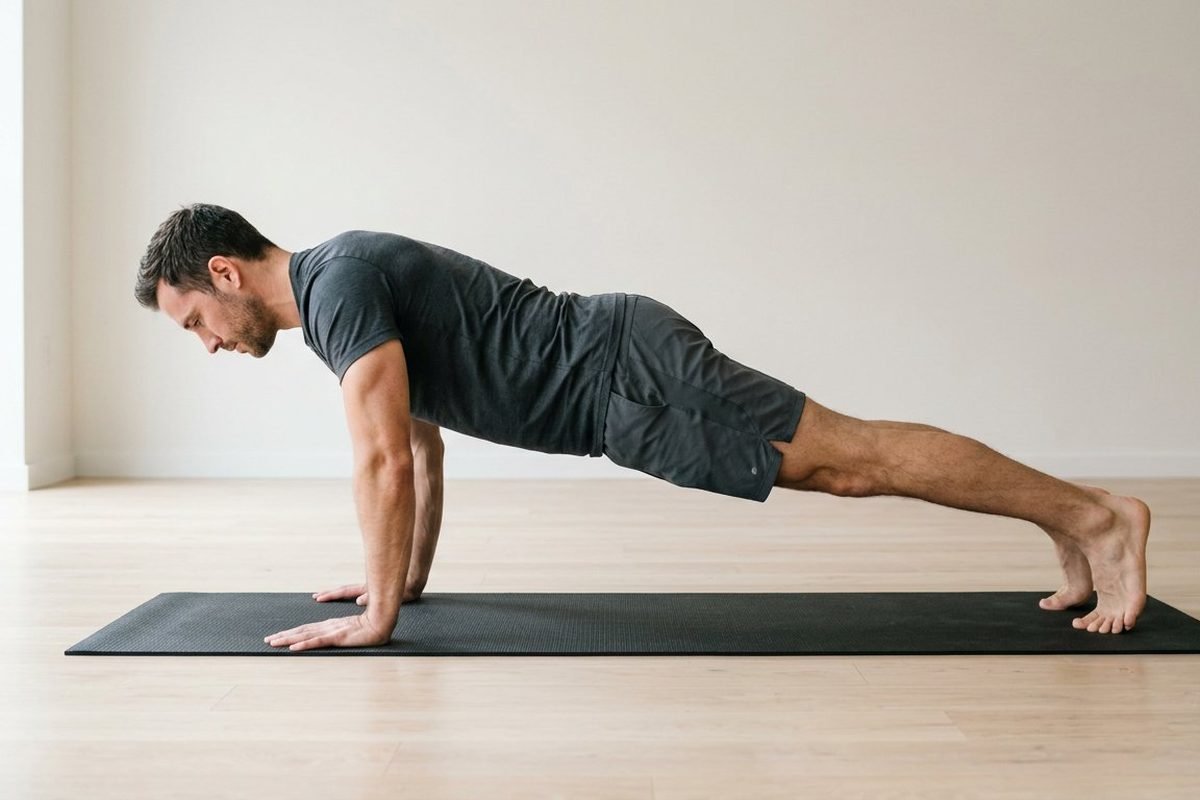
Almost everyone who says they cannot do a push-up is actually doing the hardest version of it on the hardest surface. A push-up is a moving plank that happens to involve your arms: if your hips sag, you are pressing about 65% of your bodyweight through one long, unstable line. Change the angle — hands on a wall, a bench, a step — and the same movement becomes achievable in a week.
3–5 sets of 3–8 (stop 2 reps short of failure)Volume
60–90 secondsRest
BeginnerLevel
2 seconds downTempo
Jump to instructions
Push-Up Progressions From Zero to Twenty

Why this works

Elevating your hands reduces the load you press while keeping the exact same body position, so you build the pattern at a level you can control instead of failing at full range.

Primary muscles

  • Chest
  • Triceps
  • Front shoulders

Also working

  • Core
  • Upper back
Goal
Strength
Level
Beginner
Sets & reps
3–5 sets of 3–8 (stop 2 reps short of failure)
Rest
60–90 seconds
Tempo
2 seconds down, 1 second up, 1 second pause
Est. burn
3–5 per set

Equipment

  • None
  • Wall
  • Bench or step

Set-up

  1. Hands slightly wider than shoulder-width, directly under the shoulders. Too wide turns it into a shoulder stretch; too narrow loads the triceps heavily and stresses the wrists.
  2. Fingers spread and gripping, weight through the base of the fingers — not the heel of the hand. This protects the wrist and lets you push the floor away rather than collapsing into the palms.
  3. Feet together or hip-width, whichever lets you hold the plank hardest. Wider feet are more stable; narrower feet are harder on the core.
  4. Squeeze glutes, tuck ribs down, and press the floor away to set the shoulders. This is the position you must hold through the whole set. If it collapses, end the set.

How to do it, step by step

  1. Choose your angle

    Start with hands on a wall at chest height. When you can do 3 sets of 10 with a perfect line, move to a kitchen counter. Then a chair seat, then the floor. Each step is roughly a 10–15% increase in load.

  2. Lower with your elbows at about 45 degrees

    Not flared straight out to the sides (shoulder stress) and not tucked against your ribs (triceps-only). Forty-five degrees is the sweet spot and will protect your shoulders for decades.

  3. Lower until your chest is a fist's height from the surface

    At the wall that is a small movement — do not flatten your face against it. For full push-ups, your chest should come within a few centimetres of the floor.

  4. Keep the plank: ribs down, glutes on, one straight line from ear to heel

    The most common failure is the hips sagging on the way down or the head craning forward on the way up. Film yourself from the side once — it is humbling and very useful.

  5. Press back up without shrugging

    Push the floor away and let your shoulder blades move naturally. Finish with the shoulders directly over the hands, not behind them.

Common mistakes (and how to fix them)

Hips sagging or piking

Core strength or simply too hard an angle. Go up a level (hands higher) until you can hold a 30-second dead plank with a straight line.

Head dropping toward the floor

Keep your neck long — imagine holding an apple between your chin and chest. Your chest, not your nose, should approach the floor.

Elbows flared to 90 degrees

Widen less. Think about your elbows pointing back at roughly 45 degrees from your torso.

Coaching cues & progressions

  • Wrong angle is the fastest fix in fitness. One step higher and 3 clean reps beat 8 ugly ones on the floor.
  • Do them three times a week. Push-ups respond to frequency more than to volume in a single session.
  • Add a two-second pause at the bottom once you can do 10 — it doubles the difficulty without adding reps.
  • If your wrists complain, do them on fists or on push-up handles, or use a slightly narrower hand position.

Safety notes

Never push through sharp shoulder or wrist pain. If you feel a pinch at the front of the shoulder, reduce the range and bring your elbows closer to your body. Do not let the hips lead the ascent, and do not chase reps with a shortened range. If you have an existing injury, are pregnant, or are returning to exercise after a long break, get clearance from a doctor or physiotherapist before starting.

Suitable for

Frequently asked questions

How long until I can do a full push-up?

With three sessions a week, most beginners go from zero to one full push-up in two to four weeks, and to ten reps in about eight to twelve weeks. Consistency matters far more than the specific programme.

Push-ups or bench press?

Both, eventually. Push-ups are the better starting point because they cost nothing and train core stability at the same time. Add pressing once you can do 12–15 clean reps.

Are knee push-ups okay?

They work, but they change the movement: your hips stay flexed, so you train a different position. Incline push-ups keep the exact body line you are trying to build, which is why we use them first.

Can I do push-ups every day?

You can, but you will progress faster with a day off between hard sessions. If you want daily practice, alternate hard days with a light set of 50% of your max.

Why do my shoulders click?

Usually harmless if painless. Set your shoulders down and back before each rep and keep elbows at 45 degrees. If clicking comes with pain, get it assessed.

Marcus Feld

Writes and coaches for MoveWell. Every guide is reviewed by Dr. Erik Lund, PT before publication, and updated when the evidence changes. Read more about our team and review process →

Related guides

All exercises

One workout, every Sunday

A single programmed session for the week ahead, one technique explainer, and the reader question worth answering. Written by our coaches — no supplement ads, no 5am rhetoric.

Thanks — check your inbox to confirm. You can unsubscribe in one click.

By subscribing you agree to our privacy policy. 31,000 readers, no spam.