Mobility & Recovery All levels Mobility

A 10-Minute Mobility Routine You'll Actually Do

Mobility work fails for one reason: people design a forty-minute routine they will do twice. Ten minutes, every day, covering the four areas that modern life stiffens most — ankles, hips, thoracic spine and shoulders — changes more in a month than two heroic stretch sessions ever will.
1 round dailyVolume
Continuous, no rest neededRest
All levelsLevel
SlowTempo
Jump to instructions
The 10-Minute Daily Mobility Routine

Why this works

Mobility is a skill your nervous system allows, not just tissue length. Frequent short exposure teaches your body that a range of motion is safe, which is why daily beats occasional.

Primary muscles

  • Hips
  • Ankles
  • Thoracic spine

Also working

  • Shoulders
  • Hamstrings
  • Neck
Goal
Mobility
Level
All levels
Sets & reps
1 round daily
Rest
Continuous, no rest needed
Tempo
Slow, 5 breaths per position
Est. burn
25–40 total

Equipment

  • Mat
  • Wall
  • Optional: foam roller

Set-up

  1. Do this at a consistent time — after a walk, before your shower, while the kettle boils. Habit-stacking matters more than sequence. Attach it to something you already do daily.
  2. Keep your mat rolled out and visible. A rolled-up mat in a cupboard is a routine that never happens.
  3. Move slowly and breathe out as you settle into each position. You are negotiating with your nervous system, not forcing tissue.

How to do it, step by step

  1. Ankle rocks — 45 sec per side

    Half-kneel facing a wall, front foot a hand's width from it. Drive your knee forward over your toes toward the wall, keeping your heel down. This is the ankle range you need to squat and to walk downhill.

  2. 90/90 hip switches — 60 sec

    Sit with one leg bent in front at 90 degrees and the other behind at 90. Sit tall, then rotate your knees to switch sides without using your hands. Stiff and awkward is normal at first.

  3. Deep squat hold with support — 60 sec

    Hold a doorframe or squat rack and lower into as deep a squat as you can hold. Rock gently side to side. This restores the hip and ankle range most people lose in their thirties.

  4. Thoracic rotation in quadruped — 45 sec per side

    On hands and knees, put one hand behind your head and rotate your elbow toward the ceiling, following it with your eyes. Most back stiffness that people blame on the lower back is actually a stiff mid-back.

  5. Wall slides — 45 sec

    Stand with your back and arms against a wall, elbows at 90 degrees. Slide your arms overhead while keeping contact, then back down. Expect this to feel harder and more humbling than it looks.

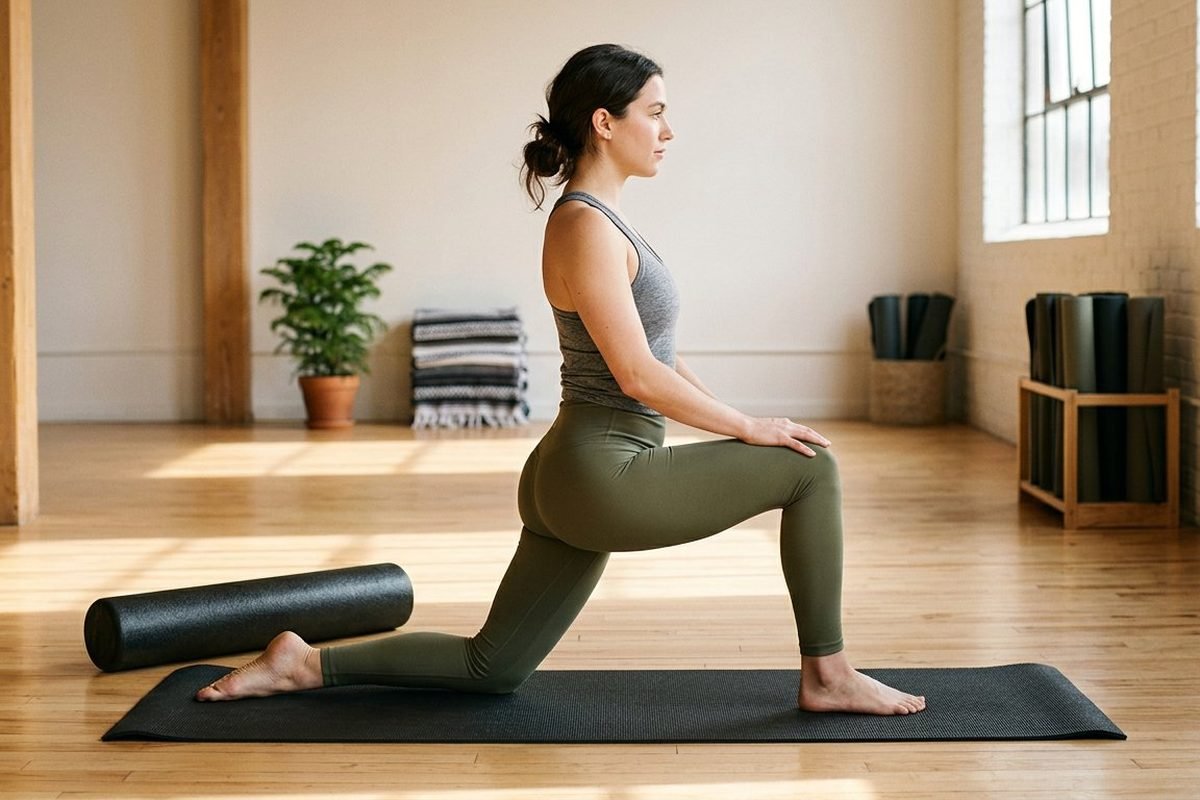
  6. Couch stretch or kneeling hip flexor — 60 sec per side

    Half-kneel with the back foot elevated on a sofa or bench if you can. Tuck your tailbone and stand tall. This is for the front of the hip, which sitting shortens most.

  7. Hamstring floss — 45 sec per side

    Lie on your back with a strap or towel around one foot. Straighten the leg to the ceiling, then actively pull it toward you while keeping the other leg flat. Do not chase the stretch; aim for a long, breathing spine.

  8. Neck and shoulder release — 60 sec

    Slow neck turns, ear-to-shoulder tilts, then shoulder circles in both directions. Finish with ten slow breaths and notice the difference in how your hips feel standing.

Common mistakes (and how to fix them)

Bouncing into end range

Bouncing triggers a protective reflex that makes you tighter. Settle, breathe, and wait for the range to arrive.

Stretching to the point of pain

Mild stretch is useful; sharp, hot or numb sensations are your nervous system asking you to stop.

Doing a long session once a week

The whole point of this routine is frequency. Ten minutes daily outperforms sixty minutes on Sunday.

Coaching cues & progressions

  • Do the ankle rocks and 90/90 before your strength sessions. Better hip and ankle range directly improves squat and deadlift positions.
  • Foam rolling is optional. If you enjoy it, roll for 60 seconds per area before, not after — it temporarily increases range.
  • Take a photo of your deep squat on day one and day thirty. Range of motion is hard to feel but easy to see.
  • If you sit for work, the couch stretch and thoracic rotation will do the most for you. Prioritise those two on busy days.

Safety notes

Never force a joint toward pain or numbness. If a movement reproduces your existing pain, skip it and get it assessed. Do not chase a deeper stretch by holding your breath or bouncing. If you have an existing injury, are pregnant, or are returning to exercise after a long break, get clearance from a doctor or physiotherapist before starting.

Suitable for

Frequently asked questions

Does stretching actually work?

Static stretching does increase range of motion, but less than the internet suggests, and gains disappear within weeks of stopping. Combining it with strength work through the same range is more effective and more durable.

Should I stretch before or after exercise?

Dynamic mobility before, longer static holds after or separately. Long static holds before heavy lifting can temporarily reduce power output.

Is foam rolling necessary?

No. It feels good and can briefly increase range, but it does not 'break up adhesions'. If you enjoy it, do it; if not, you lose very little.

Can mobility work fix my posture?

It helps, but strength and varied daily movement matter more. Posture is not a single correct shape — the ability to change position freely is the real goal.

How long until I notice a difference?

Most people feel a difference in a week and see a measurable change in 3–4 weeks. Range gained is maintained by using it, so keep the routine going.

Priya Raman

Writes and coaches for MoveWell. Every guide is reviewed by Dr. Erik Lund, PT before publication, and updated when the evidence changes. Read more about our team and review process →

Related guides

All exercises

One workout, every Sunday

A single programmed session for the week ahead, one technique explainer, and the reader question worth answering. Written by our coaches — no supplement ads, no 5am rhetoric.

Thanks — check your inbox to confirm. You can unsubscribe in one click.

By subscribing you agree to our privacy policy. 31,000 readers, no spam.