Yoga & Pilates All levels Mobility

15-Minute Morning Yoga Flow for Stiff Bodies

Most people wake up genuinely stiff — spinal discs are hydrated and joints are not yet lubricated. That is not a sign you are inflexible; it is a normal morning state. This flow is designed for exactly that: it moves the spine in all four directions, opens the hips and shoulders, and never asks you to force a stretch you do not have. If you can breathe, you can do this.
1 roundVolume
Breath-paced throughoutRest
All levelsLevel
Slow — one breath per movement minimumTempo
Jump to instructions
A 15-Minute Morning Yoga Flow

Why this works

Movement first, stretch second. Gently taking joints through range raises synovial fluid and tissue temperature, which is what actually reduces morning stiffness.

Primary muscles

  • Spine
  • Hips
  • Shoulders

Also working

  • Hamstrings
  • Calves
  • Breathing
Goal
Mobility
Level
All levels
Sets & reps
1 round, 15 minutes
Rest
Breath-paced throughout
Tempo
Slow — one breath per movement minimum
Est. burn
40–60 total

Equipment

  • Mat
  • Two blocks or books
  • Blanket

Set-up

  1. Roll out your mat somewhere you will not be interrupted for 15 minutes. Put your phone in another room. This is not a discipline flex — the point is not to check it.
  2. Have two blocks (or two hardback books) and a blanket within reach. Blocks bring the floor closer when your hamstrings or hips are tight. Using them is not cheating.
  3. Start on your back, knees bent, feet on the floor, hands on your belly. Give yourself five slow breaths before you move. Exhale longer than you inhale.

How to do it, step by step

  1. Breathing check — 5 breaths (1 min)

    Breathe in through the nose for four counts and out for six, letting your lower ribs expand sideways. Cold, stiff bodies hold their breath; this resets that pattern before you load anything.

  2. Knees to chest and gentle twist (2 min)

    Hug your knees in and rock side to side. Then drop both knees to the right, arms out wide, and look left. Hold 5 breaths, switch sides. Keep both shoulders down — that is where the rotation happens.

  3. Cat–cow (2 min)

    On hands and knees, alternate rounding and arching your spine with your breath, 8–10 times each direction. Move slowly enough that you can feel each vertebra.

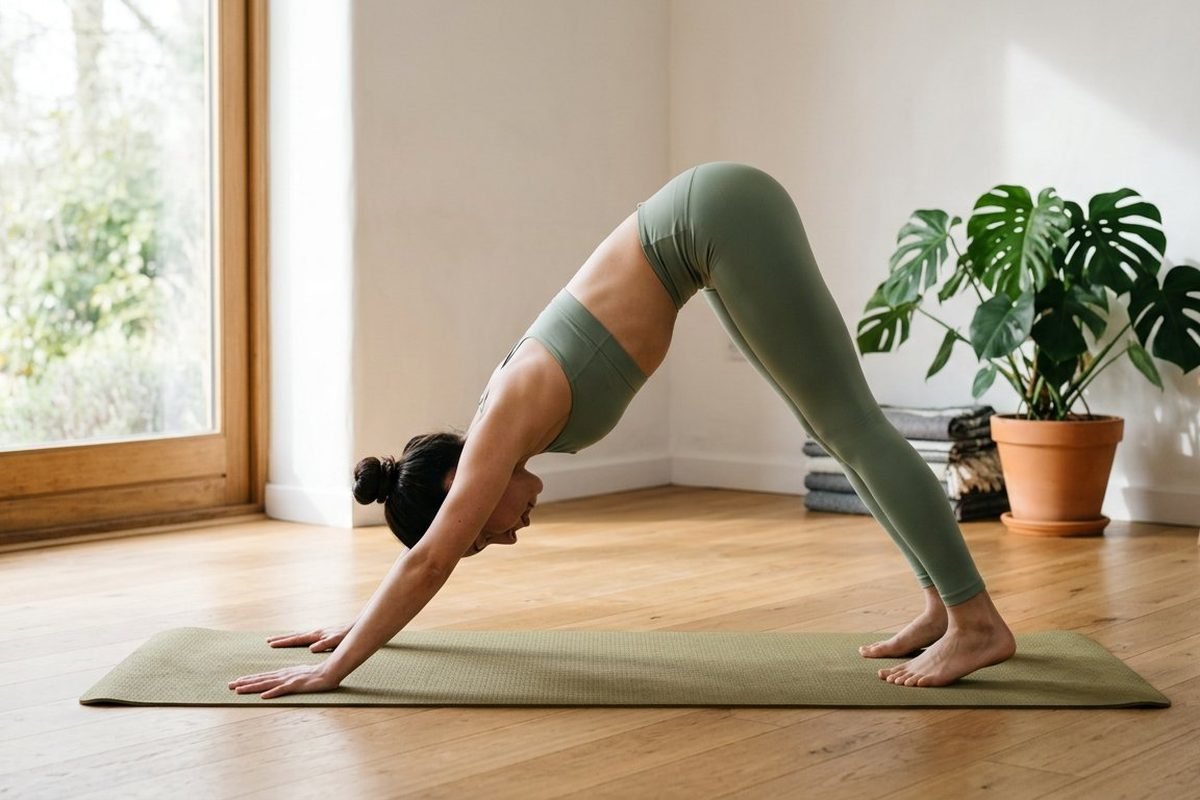
  4. Downward-facing dog, knees bent (1 min)

    Hands shoulder-width, feet hip-width, then bend your knees generously so your back can lengthen. Pedal your heels toward the floor one at a time. This is a hamstring and calf stretch that should never feel like a hamstring tear.

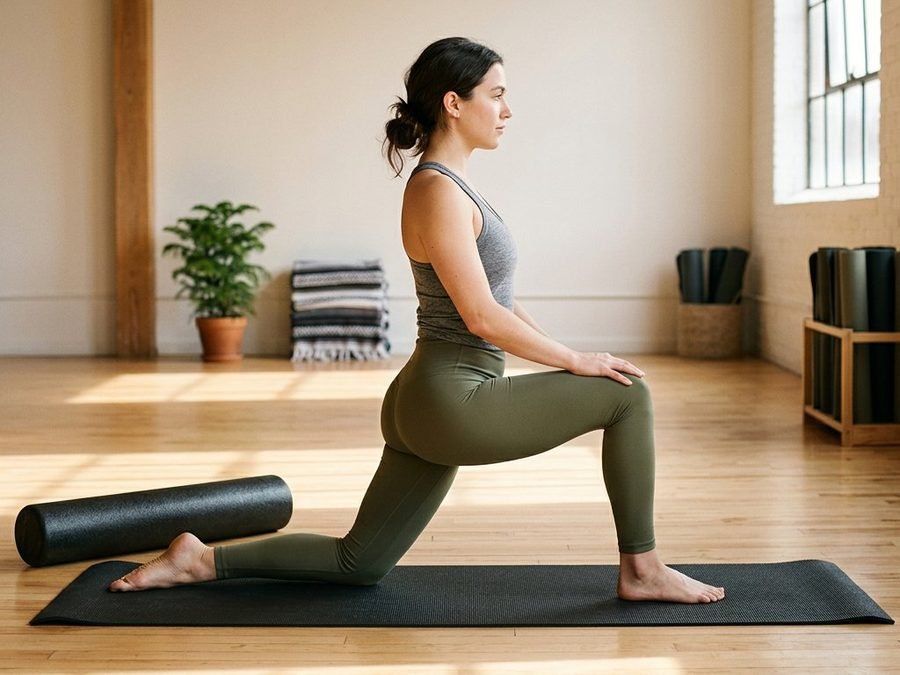
  5. Low lunge with an optional side bend (3 min, 90 sec per side)

    Step one foot forward between your hands, lower the back knee, and tuck your tailbone under to lengthen the front of the hip. Stay 5 breaths, then walk your hands to the inside of the front foot and twist gently for another 5.

  6. Half monkey / hamstring fold on a block (2 min)

    From downward dog, step one foot forward, straighten that leg, and rest your hands on blocks. Hinge from the hip with a long spine rather than rounding to reach the floor.

  7. Warrior II (2 min, 1 min per side)

    Front knee bent to about 90 degrees, back foot flat and turned in slightly, arms out at shoulder height. Keep your front knee stacked over your ankle, not caving inward.

  8. Standing forward fold and roll up (1 min)

    Bend your knees generously, hang for 5 breaths, then roll up one vertebra at a time. This is a gentle way to finish and return your spine to vertical.

  9. Seated twist and close (2 min)

    Sit cross-legged, sit on a folded blanket if your hips feel pinched, and twist gently to each side for 5 breaths. Finish with 5 long, slow breaths and one intention for the day.

Common mistakes (and how to fix them)

Bouncing into stretches

Anything that bounces is not a stretch — it is a stretch reflex, and your body will tighten in response. Settle and wait.

Straight legs in downward dog

Bend your knees so your back can be long. Hamstring length comes later; a long spine comes first.

Holding your breath in a hold

If you cannot breathe slowly in a position, you are past your current range. Back off 10% until breathing is easy.

Coaching cues & progressions

  • Do this before coffee, not after. The first fifteen minutes of the day are when stiffness is highest and the flow does the most good.
  • Never force a pose toward a single ideal shape. A bent-knee downward dog that lets you breathe is better than a straight-leg one you hold your breath in.
  • If you only have five minutes, do cat–cow, downward dog with bent knees and low lunge. You will get 80% of the benefit.
  • Keep a folded blanket by your mat. Sitting on a little height makes every cross-legged position more comfortable and lets your hips relax.

Safety notes

Never stretch into pain or numbness. If a sensation travels down a limb, tingles, or feels sharp, come out of the position immediately. Do not chase depth. Depth arrives on its own when you stop forcing it. If you have an existing injury, are pregnant, or are returning to exercise after a long break, get clearance from a doctor or physiotherapist before starting.

Suitable for

Frequently asked questions

Do I need to be flexible to start yoga?

No — that is like saying you need to be strong to start lifting. Flexibility is the outcome, not the entry requirement. Every pose here has a modification using a block, blanket or bent knee.

Is it better in the morning or evening?

Morning for stiffness and to establish the habit, evening for winding down. Either works; consistency matters more than timing. A morning flow tends to stick better.

Can I do this if I have back pain?

Often yes, and gentle movement is usually helpful for non-specific back pain. Keep the spine movements small, avoid deep forward folds if they hurt, and get individual advice if pain is sharp, recent or radiating down a leg.

What if I cannot touch the floor?

Use blocks — that is what they are for. Two blocks under your hands in a lunge or down dog bring the floor to you, and there is no rule that says your hands must be on a mat.

How often should I do this?

Five mornings a week is ideal, three is realistic, two still helps. A short daily practice beats a long weekly one.

Priya Raman

Writes and coaches for MoveWell. Every guide is reviewed by Dr. Erik Lund, PT before publication, and updated when the evidence changes. Read more about our team and review process →

Related guides

All exercises

One workout, every Sunday

A single programmed session for the week ahead, one technique explainer, and the reader question worth answering. Written by our coaches — no supplement ads, no 5am rhetoric.

Thanks — check your inbox to confirm. You can unsubscribe in one click.

By subscribing you agree to our privacy policy. 31,000 readers, no spam.