Active Aging Beginner Balance

Yoga for Seniors: Balance, Strength and Independence

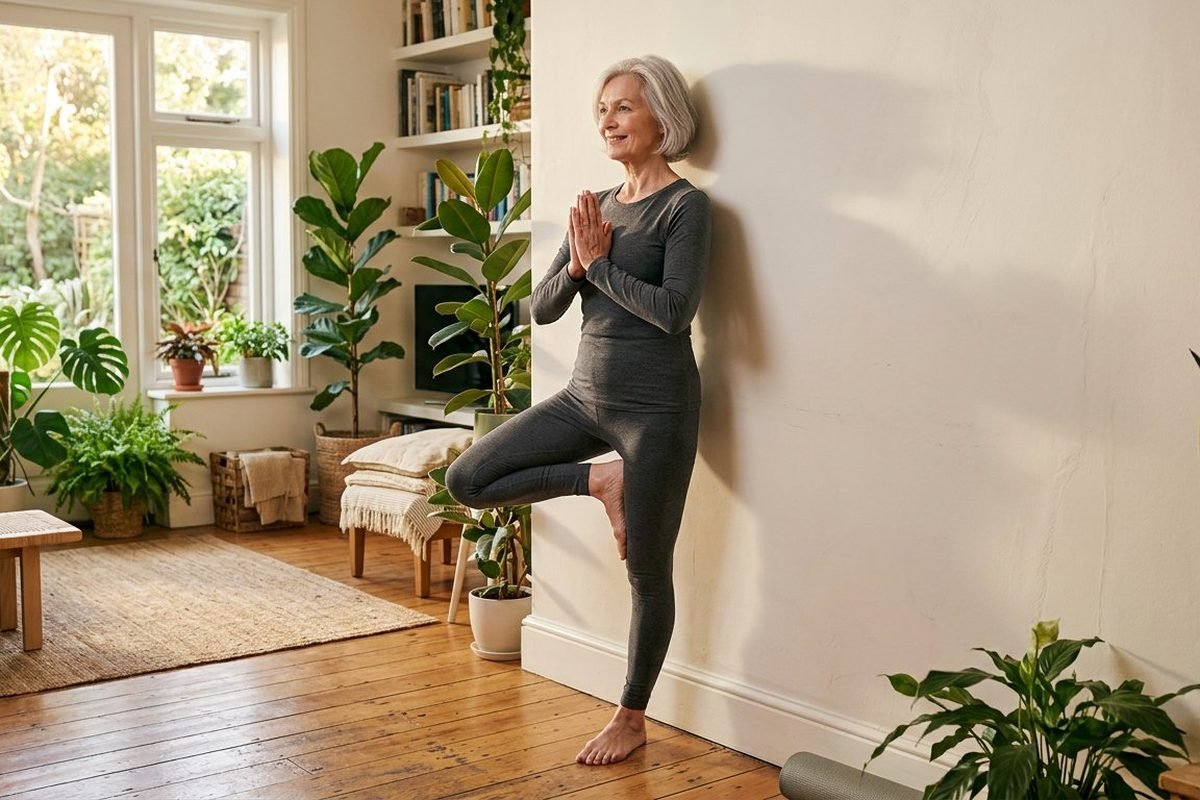
Falls are the leading cause of injury in adults over 65, and the single most effective intervention is training balance on purpose. The good news is that it barely resembles a workout: standing on one leg while holding a counter, reaching for something on a shelf, standing up from a chair without your hands. This practice trains all of it, with a chair within reach the entire time.
1 roundVolume
As needed, sit whenever you likeRest
BeginnerLevel
Slow and controlledTempo
Jump to instructions
Chair Yoga and Balance for Older Adults

Why this works

Balance is a skill, not a gift. Practising controlled instability — with support close by — improves the ankle and hip reactions that stop a stumble becoming a fall.

Primary muscles

  • Ankles
  • Hips
  • Core

Also working

  • Legs
  • Spine
  • Confidence
Goal
Balance
Level
Beginner
Sets & reps
1 round, 15–20 minutes
Rest
As needed, sit whenever you like
Tempo
Slow and controlled, 5 breaths per pose
Est. burn
30–50 total

Equipment

  • Sturdy chair
  • Wall or counter
  • Mat (optional)

Set-up

  1. Use a sturdy chair with armrests, on a non-slip surface, against a wall if possible. A dining chair is fine. A soft armchair or a wheeled office chair is not.
  2. Clear a metre of space around you and remove rugs or cables. The single best injury-prevention step in this whole session is a clear floor.
  3. Have a wall or kitchen counter within arm's reach for balance support. Fingertips on the counter is all the support you need — and you can drop to it instantly.
  4. Wear supportive shoes or go barefoot on a non-slip floor, whichever feels more stable. Socks on a wooden floor are a fall waiting to happen.

How to do it, step by step

  1. Seated breathing and posture (2 min)

    Sit tall, feet flat, hands on thighs. Breathe in for four, out for six, five times. Then roll your shoulders back and down and lengthen the back of your neck.

  2. Seated spinal twist (2 min)

    Cross your arms over your chest and turn gently to the right, holding the chair back if comfortable. Five breaths, then the other side.

  3. Seated leg extensions (2 min)

    Straighten one leg until it is parallel to the floor, hold for three breaths, lower slowly. Ten per side. This trains the quadriceps that get you out of a chair.

  4. Chair-supported sit-to-stand (3 min)

    Sit at the edge of the chair, feet slightly behind your knees, and stand up without using your hands if you can — reaching forward and pushing through your heels. Eight to ten reps. This is the highest-value exercise in the session.

  5. Supported calf raises (2 min)

    Hold the counter or chair back with both hands and rise onto your toes, then lower slowly. Fifteen reps. Strong calves are your first line of defence against a stumble.

  6. Supported single-leg stand (3 min)

    Hold the counter with both hands, lift one foot 5 cm off the floor, and hold for 10–20 seconds. Progress to one hand, then fingertips, then no hands. Five holds per leg.

  7. Supported heel-to-toe walk (2 min)

    Walking along the counter, place one foot directly in front of the other, holding on as needed. Ten steps each way. Do this near a wall.

  8. Standing wall stretch and finish (2 min)

    Hands on a wall at shoulder height, step back and let your chest drop toward the wall to open the shoulders. Five breaths. Finish seated with five slow breaths.

Common mistakes (and how to fix them)

Holding your breath during balance work

Very common, very unhelpful — breath-holding raises blood pressure. Count out loud if it helps.

Letting the knees collapse inward during sit-to-stand

Push your knees gently out over your middle toes as you stand.

Skipping the support too soon

Two hands, then one hand, then fingertips, then nothing. Each step takes as long as it takes.

Coaching cues & progressions

  • Do this where someone can hear you, or keep a phone in your pocket if you live alone. It is a precaution, not a prediction.
  • Progress by reducing hand support and increasing hold time — never by rushing the movement.
  • The sit-to-stand is the exercise most strongly linked to independence. If you only do one thing, do that, daily.
  • Practise the single-leg stand while waiting for the kettle. It adds up without adding a session.

Safety notes

Keep support within reach at all times. Stop immediately if you feel dizzy, lightheaded or unsteady, and sit down. If you have had a recent fall, work with a physiotherapist first. Do not remove hand support because you feel you should be further along. Progression, not pride. If you have an existing injury, are pregnant, or are returning to exercise after a long break, get clearance from a doctor or physiotherapist before starting.

Suitable for

Frequently asked questions

Is it safe to start yoga at 70 or 80?

Yes, with appropriate modifications — which is exactly what this session is. Chair and wall support, no floor work and no forced range make it accessible. Check with your doctor first if you have heart, balance or joint conditions, or a recent fracture.

What if I have osteoporosis?

Avoid deep forward folds, twisting under load and any position that rounds the spine hard. This session is written to avoid them, but get clearance from your doctor or physiotherapist first.

How often should I practise?

Three to five times a week. Balance gains fade quickly if you stop — this is a use-it-or-lose-it quality, so frequency matters more than duration.

I feel unsteady. Should I stop?

Feeling challenged is fine; feeling like you might fall is the signal to add support. Hold the counter. Progress only when a level feels genuinely easy.

Can I do this in a small apartment?

Easily. You need a chair-length of clear floor and a counter or wall. Nothing here requires a mat or floor space.

Priya Raman

Writes and coaches for MoveWell. Every guide is reviewed by Dr. Erik Lund, PT before publication, and updated when the evidence changes. Read more about our team and review process →

Related guides

All exercises

One workout, every Sunday

A single programmed session for the week ahead, one technique explainer, and the reader question worth answering. Written by our coaches — no supplement ads, no 5am rhetoric.

Thanks — check your inbox to confirm. You can unsubscribe in one click.

By subscribing you agree to our privacy policy. 31,000 readers, no spam.